Micro-Market Consolidation: The B2B Playbook Behind Berkshire Hathaway’s Real Estate Dominance
By: Michael D. Brosnan
When retail analysts evaluate the residential real estate market, they focus almost entirely on consumer-facing metrics: fluctuating mortgage rates, localized inventory shortages, and consumer confidence indices.
But at the enterprise level, a completely different game is being played.
Through its massive subsidiary, HomeServices of America—the corporate backbone of Berkshire Hathaway HomeServices (BHHS)—Berkshire Hathaway treats macroeconomic downturns not as a threat, but as a prime enterprise growth window. While high interest rates sideline everyday buyers and force capital-constrained, independent boutique firms to downsize, Berkshire is executing a sophisticated, counter-cyclical B2B playbook.
By analyzing Berkshire’s real estate operations through a corporate lens, executive leaders can extract a masterclass in institutional M&A, vertical ecosystem integration, and B2B platform scaling.
Counter-Cyclical M&A: Scaling via Fragmented Business Absorption
In a high-volume, booming housing market, localized independent brokerages thrive on high organic consumer demand. However, the residential brokerage industry is notoriously fragmented, leaving small-to-mid-sized business entities highly vulnerable to sudden shifts in transaction volume.
Berkshire Hathaway’s B2B growth engine is explicitly designed to capitalize on this vulnerability.
Instead of building regional offices organically—an expensive, slow, and high-risk endeavor—Berkshire utilizes an aggressive Mergers and Acquisitions (M&A) strategy targeting market-leading independent firms. When down-cycles squeeze the cash flow of independent brokerages, Berkshire positions itself as the ultimate corporate harbor.
For Berkshire, acquiring an established independent brokerage is a highly efficient, single-transaction B2B scaling lever. In one move, they absorb:
An established, localized corporate infrastructure and compliance framework.
Deep proprietary data and localized market intelligence.
An integrated, top-tier B2B talent pool (high-producing agents) who operate as independent contractors.
The B2B Franchise Model: Capital-Light Distribution
Beyond direct corporate acquisitions, Berkshire drives global footprint expansion through a highly scalable B2B franchising and affiliate network.
Under this model, Berkshire Hathaway HomeServices acts as a high-value vendor to independent agency owners worldwide. Instead of absorbing the immense capital expenditures, operational liabilities, and localized risks of running offices in London, Berlin, or Tokyo, BHHS licenses its elite brand equity, enterprise technology stack, and global cross-border referral pipeline to local business operators.
This creates a capital-light, recurring B2B revenue stream. The local business handles the boots-on-the-ground operations and human capital management, while Berkshire captures a percentage of top-line revenue simply by empowering that business with its institutional toolkit.
Total Vertical Integration: Maximizing B2B Share-of-Wallet
Perhaps the most formidable aspect of Berkshire’s real estate play is its end-to-end corporate alignment. In a traditional real estate transaction, revenue leaks out to dozens of third-party vendors—banks, title companies, escrow officers, and building suppliers.
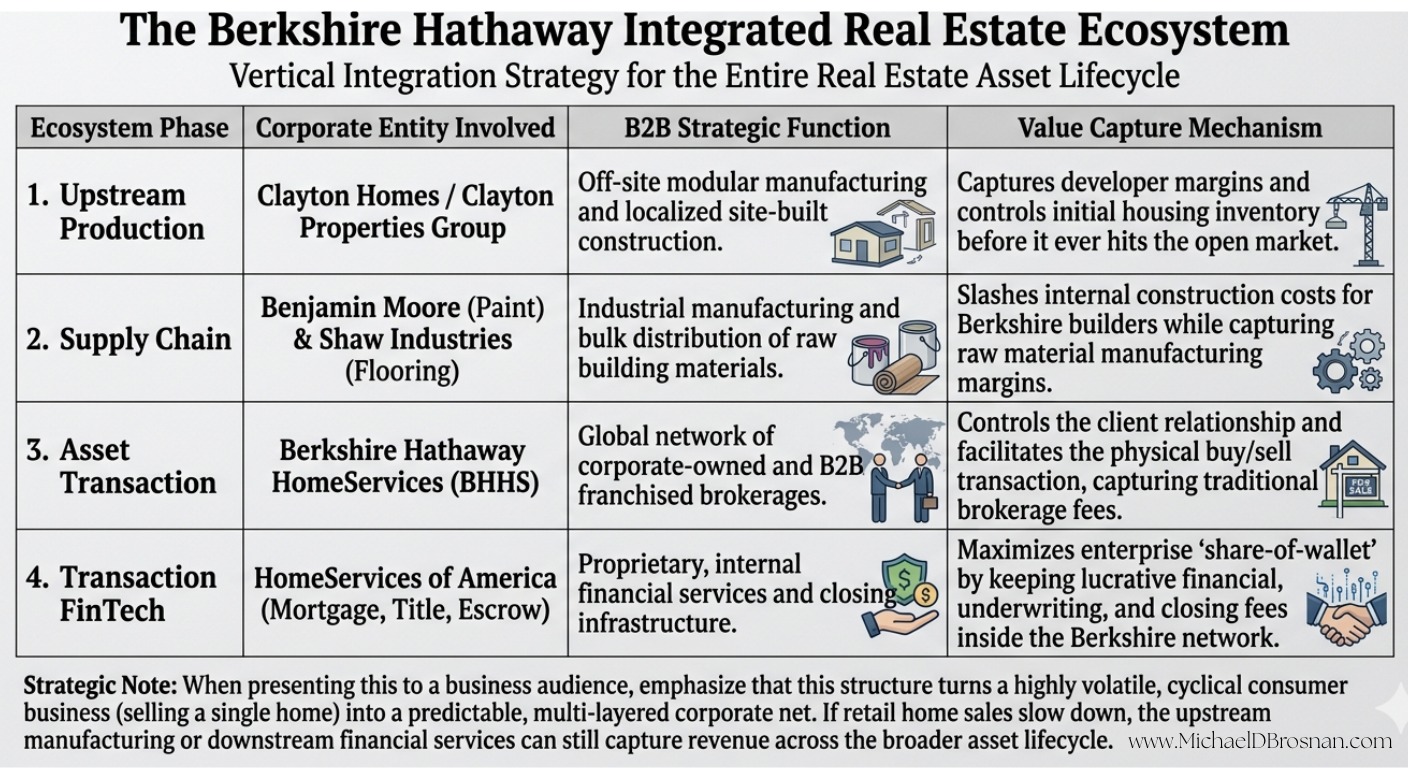
Berkshire has systematically built a closed-loop B2B ecosystem that captures margins at every conceivable phase of the asset lifecycle:
Created & Edited by Michael D. Brosnan
When a BHHS brokerage manages a transaction, internal corporate workflows are optimized to funnel that client directly into HomeServices of America’s proprietary mortgage, title, and escrow services.
Furthermore, through Berkshire’s ownership of Clayton Homes (offsite modular and site-built housing) alongside manufacturing giants like Benjamin Moore (paint) and Shaw Industries (flooring), the conglomerate acts as its own B2B supplier, distributor, and broker. This vertical integration ensures that even if one sector of the market slows down, the enterprise as a whole captures value from the raw materials up to the final closing signature.
The B2B2C Talent Proposition
In the real estate sector, top-producing agents are essentially micro-businesses. They choose their corporate banner based entirely on the B2B value proposition the parent company offers them.
During prolonged market corrections, smaller brokerages often slash marketing budgets, reduce technology spending, and compromise on administrative support. Berkshire leverages its fortress balance sheet—backed by a massive corporate cash reserve—as a powerful B2B recruiting tool. By offering agents unmatched operational stability, cutting-edge predictive CRM tools, and an elite global luxury marketing platform, Berkshire systematically poaches top-tier talent away from struggling competitors.
When you win the business loyalty of a top-producing agent (B2B), their entire portfolio of consumer clients (B2C) naturally migrates with them.
The Strategic Takeaway
Berkshire Hathaway’s real estate methodology proves that market downturns are the ultimate equalizer for capitalized enterprises. While the consumer-facing market waits out macroeconomic volatility, Berkshire is busy wiring the backend infrastructure of the industry.
By executing strategic B2B consolidation when capital is expensive for everyone else, Berkshire ensures that when the macroeconomic tide turns, its fully integrated corporate machine is positioned to capture the lion's share of the rebound.