Wings for the Wingless: What a Red Bull Acquisition of Spirit Airlines Teaches Us About B2B Growth Strategy
By: Michael D. Brosnan
The sudden collapse and liquidation of Spirit Airlines has left a gaping hole in the ultra-low-cost carrier (ULCC) market. While legacy airlines are quickly absorbing Spirit’s former routes and a community-led crowdfund attempts a longshot "Spirit 2.0" cooperative, a much more radical, hypothetical B2B growth play deserves exploration.
What if Red Bull bought the remnants of Spirit Airlines?
On the surface, a premium energy drink empire buying a defunct, stripped-down budget airline sounds like a corporate fever dream. But looking at it through the lens of modern B2B strategy, market entry, and ecosystem expansion, the synergy is remarkably sharp.
Here is how a Red Bull takeover of Spirit’s assets serves as a masterclass in aggressive, unconventional corporate growth strategy.
Asset Liquidation as a Low-Cost B2B Market Entry
For any brand looking to enter a heavily regulated, capital-intensive industry, the barriers to entry are staggering. Starting an airline from scratch requires years of FAA certifications, securing elusive airport slots, and billions in capital expenditure.
By eyeing Spirit’s current liquidation proceedings, an outside giant like Red Bull avoids the premium valuation of a functional company. Instead, they acquire infrastructure—gates, landing slots at major hubs, maintenance facilities, and an established supply chain—at fire-sale prices.
The B2B Lesson: True market disruption rarely happens by building infrastructure from scratch. Strategic growth often means waiting for a market correction or liquidation event to buy distressed operational infrastructure, bypassing years of regulatory and logistical friction.
Flipping the Monetization Model: From Seats to Sponsorships
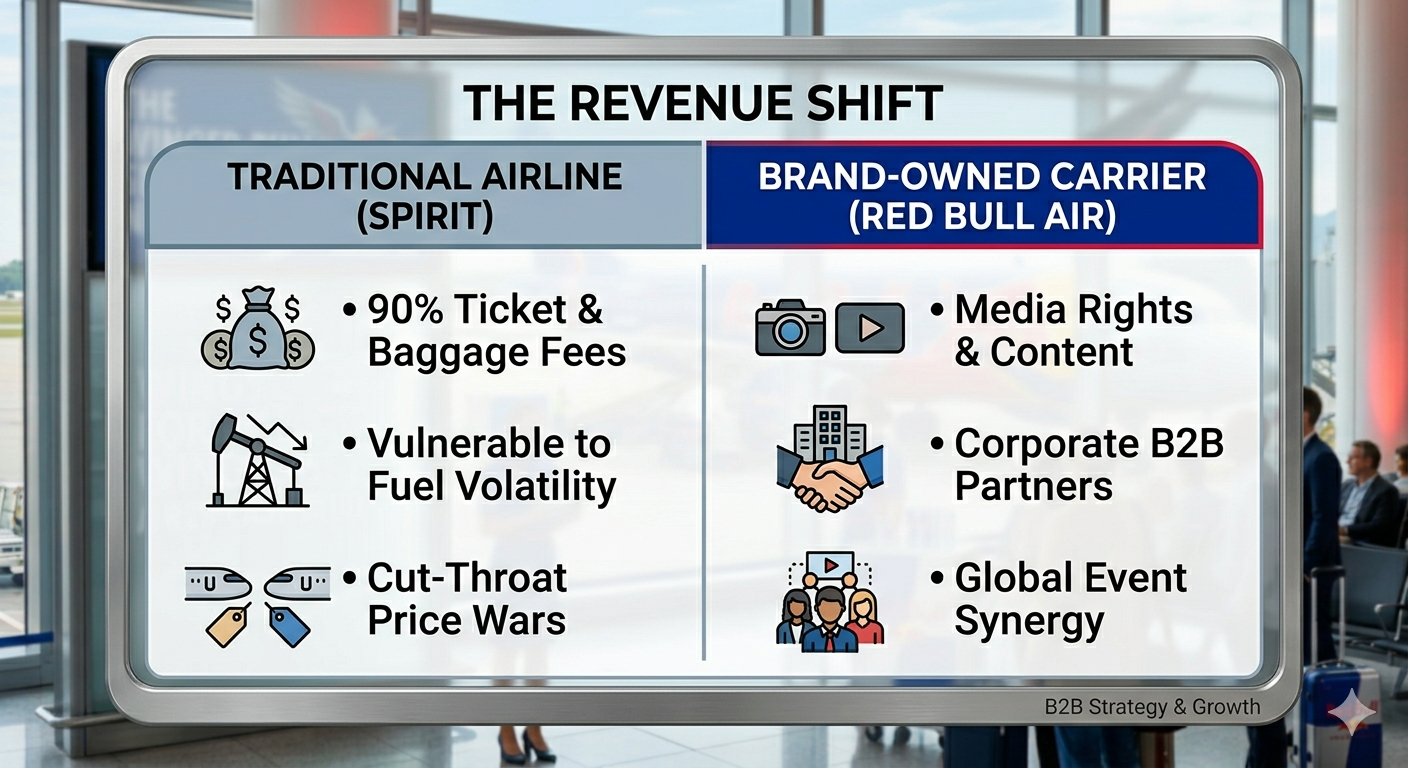
Spirit Airlines collapsed because its ultra-low-cost business model could not withstand surging jet fuel costs. Spirit relied entirely on high-volume passenger ticket sales and aggressive ancillary fees (baggage, seat selection) to survive.
Red Bull doesn’t need to make money on the ticket.
Red Bull is fundamentally a marketing machine that happens to sell beverages. They spend roughly 20–30% of their revenue on marketing, funding everything from Formula 1 teams to space jumps. Under Red Bull ownership, an airline transforms from a low-margin transportation service into a massive, self-sustaining B2B media asset and experiential marketing platform.
Created & Edited by Michael D. Brosnan
By shifting the primary KPI from "passenger yield per seat" to "global brand impressions and B2B partnership revenue," Red Bull could subsidize the operational losses that broke Spirit, offering dirt-cheap flights while monetizing the attention of millions of captive passengers.
Creating a B2B Experiential Ecosystem
Red Bull’s growth strategy has always centered on owning the ecosystem. They don't just sponsor extreme sports; they own the teams, the media production houses (Red Bull Media House), and the venues.
An airline completes the loop. A "Red Bull Air" (rebranded from Spirit) becomes the literal logistics engine for their global B2B operations:
Corporate Jet Pooling: Moving athletes, musicians, production crews, and corporate partners seamlessly between global events.
B2B Ad Network: Transforming the interior cabin, in-flight entertainment, and airport gates into high-value advertising real estate for Red Bull’s corporate partners (GoPro, Puma, etc.).
Exclusive Hospitality: Offering premium B2B travel packages to corporate clients, inclusive of flights, luxury transport, and VIP access to events like the Miami or Las Vegas Grands Prix.
Radical Brand Resuscitation
Spirit Airlines’ greatest asset was its footprint; its greatest liability was its brand reputation. It was famously lampooned for its no-frills, frustrating customer experience.
Red Bull possesses the unique cultural equity required to execute a total brand inversion. By injecting their signature high-octane branding, sleek asset design, and a culturally relevant customer experience, they instantly transform "the airline everyone hates to fly" into "the experiential flight everyone wants to post about on social media."
The Strategic Takeaway for B2B Leaders
While Red Bull buying Spirit’s liquidated assets remains a fascinating strategic thought experiment, the underlying business mechanics are highly applicable to any B2B growth playbook:
Look Beyond Your Vertical: Growth often lies in vertical or lateral asset integration. Ask yourself: What utility or logistics company could we absorb to supercharge our core business?
Capitalize on Distressed Assets: Keep a close eye on industry-wide pain points (like the current fuel crisis hitting regional transit). Distressed assets are opportunities to acquire market share and infrastructure at a fraction of the cost.
Monetize the Audience, Not Just the Product: If your B2B strategy only focuses on selling a commoditized service, you are vulnerable to margin compression. Figure out how to turn your operational footprint into a media or data asset.
In a business landscape where traditional boundaries are blurring, the companies that win won't just expand their existing product lines—they will acquire the infrastructure to control entire consumer and commercial ecosystems.