The Talent Warehouse: How Operations Transformed the Job Market into a Data Goldmine
By: Michael D. Brosnan
The corporate recruiting landscape has fundamentally shifted, not because businesses have become inherently detached, but because modern operational leaders are aggressively capitalizing on the powerful digital leverage sitting right in front of them. In the world of enterprise operations, efficiency relies on converting a reactive process into a predictive, highly strategic machine. When viewed through the lens of pure business optimization, the frustrating cycle of persistent job postings and rapid-fire, automated rejection emails reveals itself to be a masterclass in modern asset building and data management.
Historically, recruitment was a just-in-time logistics model where an organization only initiated a talent search when an active vacancy created an immediate operational bottleneck. Today's forward-thinking organizations recognize that talent acquisition is far more effective when treated as a continuous raw material pipeline. By maintaining active, continuous digital listings—often referred to as evergreen roles—businesses are strategically warehousing a massive, self-updating talent data lake. This ongoing accumulation allows an organization to remain incredibly agile. Instead of losing weeks spinning up a net-new recruitment campaign when an unexpected market demand hits or a critical team member leaves, operations can instantly dip into a highly refined, pre-harvested repository of qualified candidates. It is a brilliant operational pivots away from expensive, rushed hiring cycles toward a zero-lead-time supply chain for human capital.
This strategy is fueled by the incredible technical capabilities of contemporary Applicant Tracking Systems, which automate the heavy lifting of sorting, grading, and organizing these vast influxes of information. For a business scaling its operations, human hands cannot efficiently process thousands of applications per week without becoming a massive cost center. Instead, organizations lean heavily into automated infrastructure to filter data efficiently.
Algorithmic keyword filtering acts as a baseline quality control mechanism, instantaneously parsing resumes for exact technical competencies and operational credentials.
Automated batch sequencing holds non-matching applications in a queue and releases standardized status updates systematically, freeing up thousands of hours for HR personnel to focus purely on high-priority executive tasks.
Continuous programmatic renewal keeps active listings visible at the top of digital job boards via automated scheduling, ensuring a steady, effortless stream of inbound data without requiring daily human intervention.
Simultaneously, the major networking platforms and digital job boards are maximizing their own market leverage by facilitating this continuous loop. These platforms are incentivized to provide enterprise employers with maximum utility for their recurring software subscriptions, which means giving them the tools to run wide-reaching, permanent talent-scouting networks. For the platforms, every resume submitted, every skill set logged, and every digital interaction captured represents premium, structured behavioral data that optimizes their core matching algorithms. It creates a powerful, symbiotic business environment where platforms gain high user engagement metrics to display to their stakeholders, while corporations successfully de-risk their future workforce needs by hoarding valuable talent insights.
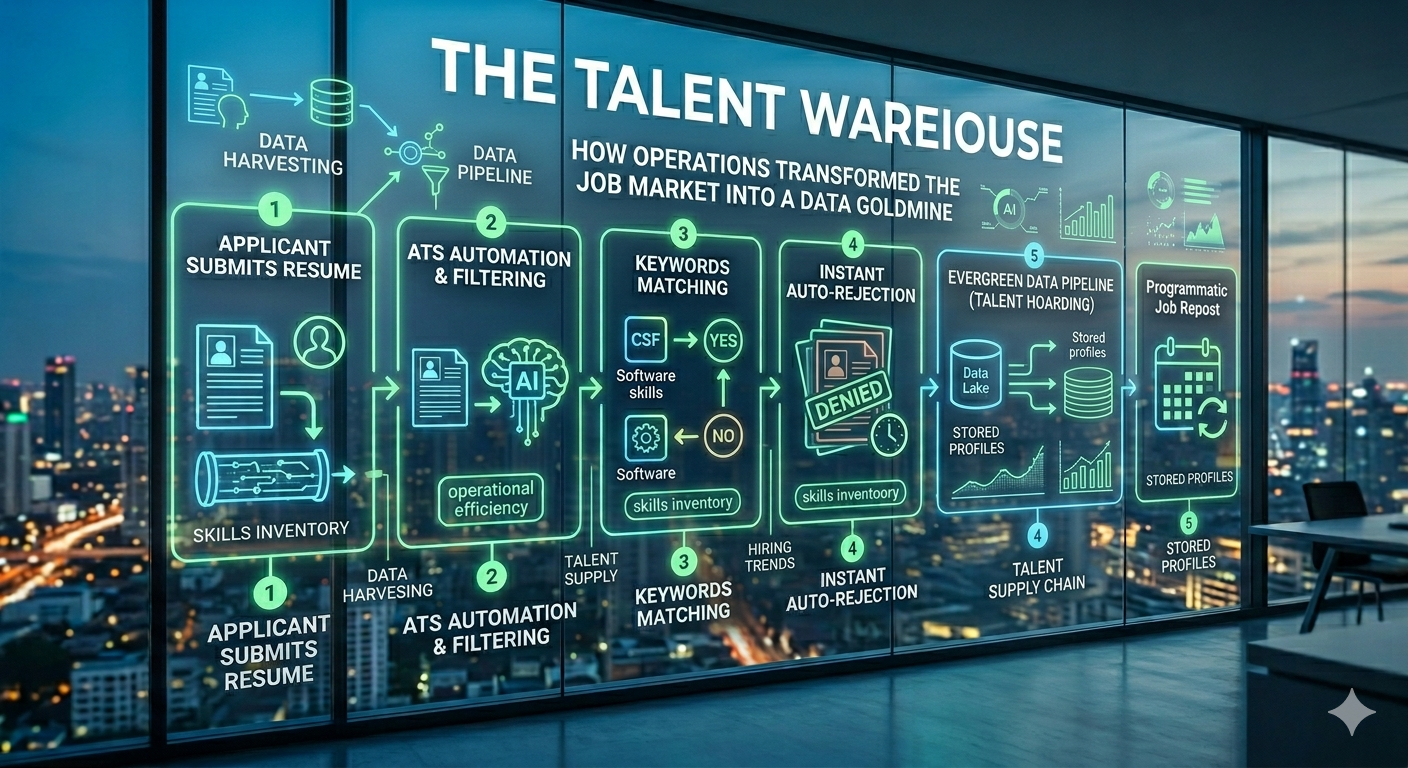
Image generated by Gemini
For an industry observer or an active professional navigating this landscape, understanding this operational framework is the key to mastering it. The traditional front door of an application portal is increasingly engineered to serve as a data ingestion point rather than an immediate interview gateway. Recognizing that organizations are leveraging automation to filter for highly specific operational profiles means that success belongs to those who learn to work with the system's structural logic. By aligning communication perfectly with automated criteria, or by skipping the automated gatekeeper entirely to build direct relationships with internal operational decision-makers, professionals can step out of the automated data loop and position themselves precisely where an organization’s future talent pipeline meets its immediate strategic execution.