Ditching Cost-Per-Unit: How to Pitch "Total Value" Supply Chains to the Boardroom
For decades, corporate finance departments have forced supply chain operations into a rigidly narrow box. Procurement and logistics teams have traditionally been evaluated on their ability to hit one specific, unyielding metric: minimizing the immediate, transactional cost-per-unit. This traditional framework treats the purchase price of a raw material or a baseline ocean freight quote as a static, isolated victory. When a procurement manager shaves two dollars off a component by single-sourcing it from a distant, low-cost global hub, the standard accounting ledger registers an immediate win, corporate bonuses are calculated, and the boardroom moves on.
The dangerous flaw in this unit-level accounting model is that it treats supply chain economics as if they exist in a perfect, frictionless vacuum. The cascading global disruptions of recent years have proven that the absolute cheapest supply chain on a spreadsheet is almost always the most brittle, highly volatile, and financially exposed in the real world. When that single, low-cost overseas factory hits a localized power grid failure, a port strike, or an unexpected trade shutdown, the hidden liabilities of that "cheap" unit explode exponentially. The subsequent operational fallout; unabsorbed factory overhead, emergency air-freight premiums to prevent assembly line stoppages, and lost market share due to stock outs; instantly wipes out years of paper savings in a matter of days.
Traditional financial reporting is fundamentally unequipped to trace these catastrophic operational losses back to the original sourcing decision. Instead, these massive, reactive expenses show up months later buried inside general corporate overhead or as sudden quarterly write-offs, creating a dangerous optical illusion where high-risk procurement strategies look incredibly profitable right up until the exact moment they implode. This creates a severe structural trap for logistics and operations executives. In the middle of a major crisis, the C-suite loudly demands absolute resilience, agility, and flexibility. Yet, the moment the immediate disruption passes, corporate finance default mechanisms revert right back to tracking short-term transportation spend and purchase price variance, penalizing the very leaders who saved the network.
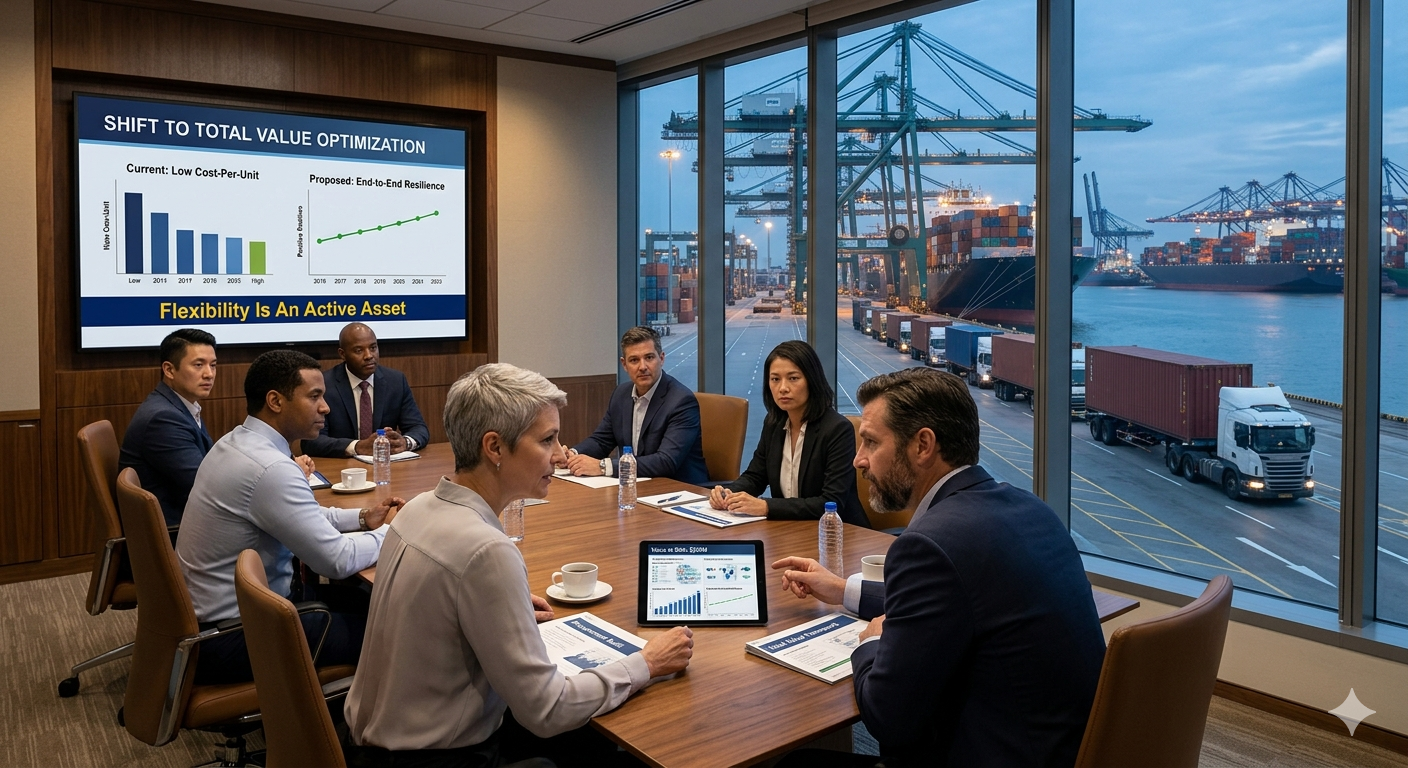
Breaking out of this cycle requires operations leaders to stop pitching resilience as a vague, defensive risk-mitigation insurance policy. The boardroom does not respond to abstract operational anxiety; it responds exclusively to the language of capital preservation, risk quantification, and revenue growth. To change the conversation, supply chain executives must actively pivot from a defensive Total Cost of Ownership model toward a proactive strategy of Total Value Optimization.
Under a Total Value framework, a diversified sourcing strategy or a local fulfillment backup isn't viewed as a redundant expense that penalizes immediate margins. Instead, it is framed as a strategic financial option that grants the corporation the agility to capture market share when competitors are completely locked down. If a localized disruption lines up against a primary vendor, a company that has invested in an active, secondary nearshore partner can seamlessly shift production volumes within 48 hours. The ability to continuously fulfill customer orders while industry peers face months of backlogs translates directly into competitive customer acquisition, brand loyalty, and the preservation of top-line revenue; metrics that resonate directly with the Chief Financial Officer and the Board of Directors.
To successfully pitch this approach and rewrite the corporate playbook, logistics leaders must come to the table armed with structured financial models rather than operational platitudes. First, operations must replace vague warnings about supply chain risk with a concrete calculation of Value at Risk. If a ten-dollar component controls the assembly of a ten-thousand-dollar finished product, the true financial exposure of a supplier failure isn't the cost of the component, it is the entire daily revenue output of the manufacturing facility. Presenting a clear financial model that contrasts a massive potential daily revenue loss against a small annual premium to onboard a backup vendor completely alters the boardroom's risk calculation.
Additionally, logistics teams need to audit their networks to establish a definitive Time-to-Recover for every critical product line. This measures the exact number of days it takes for a supply chain to return to full operational capacity after a primary hub, factory, or transport lane goes completely dark. By mapping this operational recovery timeline directly against the company's existing inventory safety buffers, you can show the exact day a disruption crosses the threshold from a minor operational headache into a direct hit on corporate liquidity.
Finally, forward-thinking logistics teams must prove that an agile, digitally visible network actually compresses the corporate Cash-to-Cash cycle. A brittle supply chain built purely on cost-per-unit forces a company to hoard massive, reactive "just-in-case" inventory piles at the wrong nodes in the network, trapping millions of dollars in liquid working capital. By demonstrating that a responsive, diversified network allows for lower, more precise baseline inventory levels, you transform the supply chain from a back-office cost center into an active engine for capital efficiency. The ultimate goal is to make the executive suite realize that supply chain flexibility is an active asset, and building a resilient network is the only statistically viable way to protect the bottom line in a highly volatile global market.