The Free Ride is Over: Why North Carolina is Threatening to Upend the AI Supply Chain
By: Michael D. Brosnan
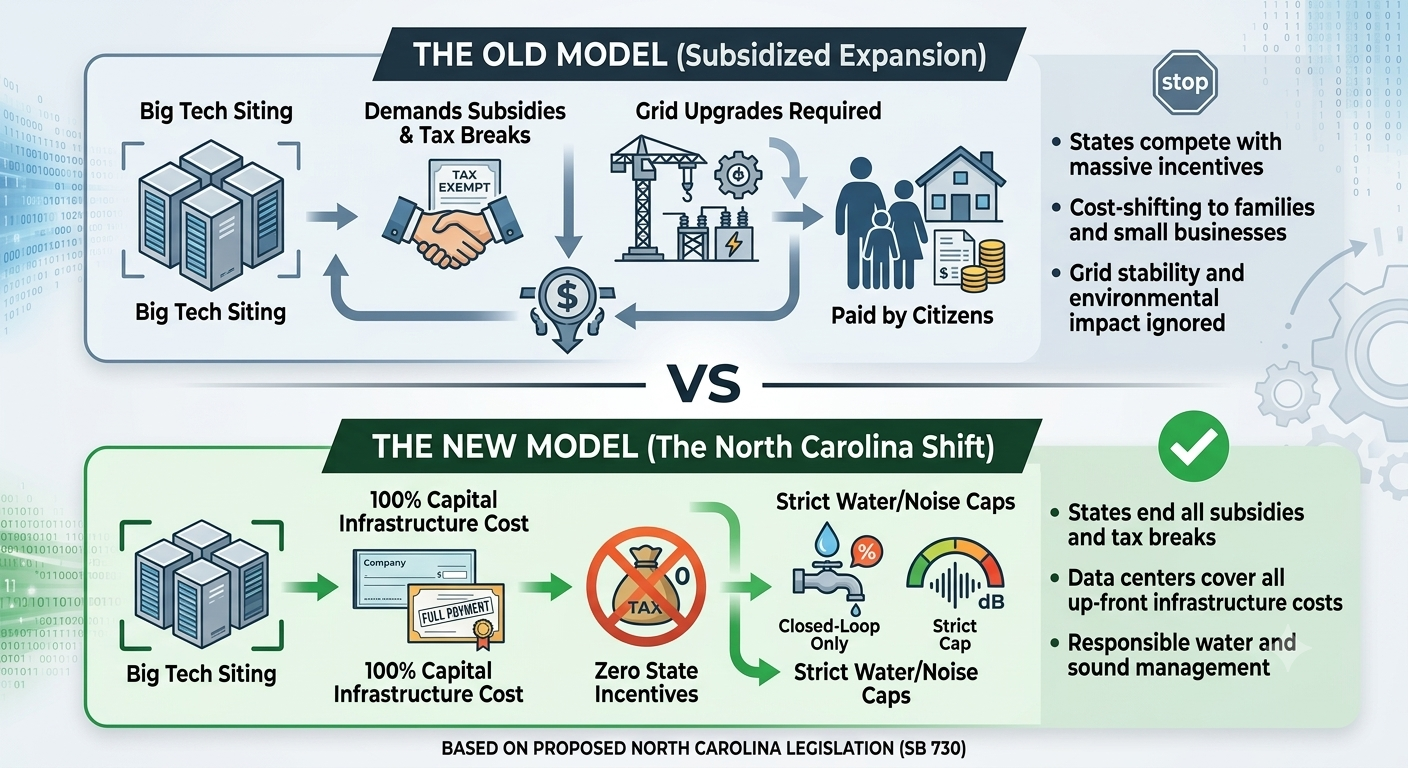
For the last decade, the playbook for big tech expansion was simple: pick a state, demand a mountain of tax incentives, hook up to the local power grid, and let the local taxpayers quietly subsidize the infrastructure upgrades required to run your massive server clusters.
States competed in a literal race to the bottom to see who could give away the most to land a shiny new data center.
But the sheer, unquenchable power demands of generative AI just broke that model.
The North Carolina House of Representatives just threw a massive wrench into the gears of digital infrastructure logistics by passing Senate Bill 730; the Ratepayer Protection Act. Passed with a bipartisan 69-44 vote, the bill signals a massive vibe shift in how states view tech giants: the free ride is officially over.
The Reality of the Megawatt Choke Point
We talk about "the cloud" like it’s a magical, weightless entity. It isn't. It's a collection of massive, concrete warehouses packed with hot silicon that eats electricity and spits out heat. It is a physical logistics problem.
Consider the numbers Duke Energy is facing right now:
7.6 gigawatts in active electric service agreements with data centers.
2.7 gigawatts tacked on just in the first quarter of 2026.
Another 15.4 gigawatts currently in pipeline discussions.
To put that in perspective, a single gigawatt can power roughly 750,000 homes. The local grid cannot absorb that kind of load without a staggering amount of capital investment. Historically, utilities just passed those expansion costs onto residential families and small businesses.
North Carolina's bill targets any facility eating more than 100 megawatts per month and draws a hard line: Pay your own way, or don't build here.
The New Siting Math
If this bill passes the Senate and hits the governor's desk, it completely rewrites the financial models for B2B infrastructure development and site selection.
1. The Death of the Incentive Carrot
For years, site selectors looked at tax breaks first and infrastructure second. SB 730 completely strips local and state governments of the ability to hand out tax incentives to these mega-facilities. If you want to build, you do it on your own dime.
2. Infrastructure as a Direct Capital Expense
Under a full cost-recovery model, data center operators can no longer rely on utilities to socialize the cost of grid upgrades. If a project requires a new substation or reinforced high-voltage lines, the tech company pays 100% of the bill up front.
3. Strict Physical Constraints
The bill moves past just money and regulates resources. Data centers will be forced to use closed-loop liquid cooling systems to stop them from draining local water tables and must conduct aggressive noise impact assessments if they are anywhere near residential zones.
Why the Rest of the Country is Watching
What's happening in Raleigh isn't a localized anomaly; it’s a blueprint. From the data center alleys of Virginia to the tech hubs of Texas and Ohio, local grids are redlining under the weight of AI computing clusters.
Public sentiment has shifted sharply. A recent Carolina Journal poll showed that 78.2% of voters—regardless of political party—believe data centers should generate or entirely pay for their own energy infrastructure. When nearly 8 in 10 voters in a swing state agree on tech regulation, politicians notice.
For B2B growth strategists and logistics professionals, the takeaway is clear: the era of cheap, heavily incentivized digital infrastructure is coming to a close. Moving forward, the true cost of scale will have to be baked directly into the balance sheet.